
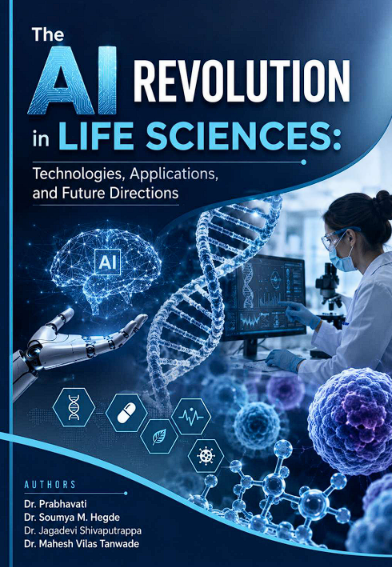
The AI Revolution in Life Sciences: Technologies, Applications, and Future Directions
Dr. Prabhavati, Dr. Soumya M. Hegde, Dr. Jagadevi Shivaputrappa and Dr. Mahesh Vilas Tanwade
FORMAT
Paperback and e–book
ISBN
978-93-49359-23-9
DOI
doi.org/10.5281/zenodo.22124918
PAGES
177 pages
PRICE
Rs. 1000/- ($50)

About The Authors

Dr. Prabhavati is an Assistant Professor in the Department of Zoology at K.L.E. Society's S. Nijalingappa College, Rajajinagar, Bengaluru, Karnataka, India. She received her Ph.D. in Zoology from Gulbarga University, Kalaburagi in 2019, with a dissertation named "Hydrobiological Studies of Kamalavati River of Sedam Taluka, Kalaburagi District," which focused on limnology, ecotoxicology and aquatic biodiversity. Prior to her current position, she worked as an Assistant Professor for eight years of teaching both undergraduate and postgraduate courses, actively contributing to academic curriculum development and guiding numerous student research projects. Her main research and teaching interests include Ecology, Biodiversity Assessment, Wildlife Management, Ethology, Genetics and Molecular Biology, Anatomy, Physiology and Reproductive Biology. Dr. Prabhavati, has published six research papers, serves as a peer reviewer for academic journals, develops undergraduate instruction and laboratory manuals and has presented at national and international conferences. She has been honoured with the Women Icon Award (2025).

Dr. Soumya M. Hegde is an Assistant Professor in the Department of Botany at KLE Society’s S. Nijalingappa College, Rajajinagar, Bengaluru, Karnataka, India. She completed her Ph.D. in Botany from Sahyadri Science College, Kuvempu University, Shivamogga in 2024 with the research title “Diversity and Biology of Terrestrial Orchids in Shivamogga District, Karnataka.” Her doctoral work focused on terrestrial orchid diversity, distribution, phenology, reproductive Biology, mycorrhizal associations, and conservation in the Western Ghats of Karnataka. Her areas of teaching and research interest include Plant Taxonomy, Orchid Biology, Plant Ecology, Biodiversity Assessment, Plant Conservation, Mycorrhizal Associations, Plant Anatomy, Phytochemistry, Ethnobotany, Medicinal Plants, and Plant Secondary Metabolites. She has conducted extensive field surveys across the Western Ghats, documented orchid diversity, carried out anatomical and ecological studies, and contributed to biodiversity conservation research. Dr. Hegde has published 18 research papers in the areas of orchid diversity, phenology, plant anatomy, and biodiversity of the Western Ghats. She is actively involved in undergraduate teaching, laboratory instruction, curriculum development, preparation of practical manuals, question banks, and academic mentoring. She has also served as a reviewer for graduate research synopses. She has presented research papers at several national and international conferences and participated in numerous workshops, seminars, and training programmes related to biodiversity, orchid conservation, plant taxonomy, ecology, and research methodology. Dr. Hegde is a life member of The Orchid Society of India and a member of the International Society for Horticultural Science (ISHS). She is committed to promoting scientific research, biodiversity conservation, and quality higher education through field-based learning, innovative teaching, and interdisciplinary research

Dr. Jagadevi Shivaputrappa is a Guest Lecturer in the department of Botany, Gulbarga University, Kalaburagi, Karnataka, India. Her areas of interest in teaching and research include Medicinal plants, Agricultural biotechnology, Plant breeding, molecular biology, microbiology and genetic engineering.She publidshed 5 research articles in reputed national and international journals and a book chapter in cambridge scholars publishing house, UK and presented her research work in several in several national and international conferences. She is actively involved in curricular and co-curricular enrichment activities. She is an active member of MycoAsia and institutional botanical society. She aspires to make a significant contribution to research and eduction.
Dr. Mahesh Vilas Tanwade is an Assistant Professor in the Department of Postgraduate Studies and Research in Zoology at Sharnbasva University, Kalaburagi, Karnataka, India. With over four years of academic and research experience, he actively mentors postgraduate and doctoral scholars, currently supervising three research students. He holds a Ph.D. and an M.Sc. in Zoology from Sharnbasva University and obtained his undergraduate studies from Sharnbasveshwar College of Science, Kalaburagi affilated to Gulbarga University, Kalaburagi. Dr. Mahesh Vilas Tanwade’s core research expertise lies at the intersection of endocrinology, reproductive biology, and ecotoxicology. Utilizing rodent animal models, his work explores male fertility, the neuroendocrine regulation of copulatory behaviors—including mounting, intromission, and ejaculation— and the adverse physiological impacts of endocrine-disrupting chemicals (EDCs). His research integrates standard toxicological and endocrine assays, such as the Hershberger, uterotrophic, and repeated-dose toxicity tests, alongside comprehensive semen analysis, to advance strategies in reproductive healthcare and environmental risk assessment. Dr. Mahesh Vilas Tanwade is an active contributor to the scientific community and has published several research papers in peerreviewed International Journals, including Comparative Clinical Pathology, Biological Trace Element Research, and the Journal of Molecular Structure. He has presented his scholarly findings at leading institutions, such as Dr. B. Lal Institute of Biotechnology, Jaipur, and Banaras Hindu University (BHU), Varanasi. Dr. Mahesh Vilas Tanwade holds life memberships in several professional organizations, including the Indian Society for the Study of Reproduction and Fertility (ISSRF), the Laboratory Animal Scientists Association (LASA), India, and the Society of Clinical Research and Medical Professionals (SCRMP), USA.
About The Book
The AI Revolution in Life Sciences: Technologies, Applications, and Future Directions explores the transformative role of Artificial Intelligence (AI) in life-science research, healthcare, biotechnology, agriculture, and biological engineering. The book provides a concise and accessible overview of AI technologies, applications, opportunities, and challenges shaping this rapidly evolving field. It introduces key concepts such as machine learning, deep learning, natural language processing, computer vision, predictive analytics, and generative AI, highlighting their ability to process complex datasets, identify patterns, improve prediction, and support scientific decision-making. The book examines important applications of AI in drug discovery, disease diagnosis, precision medicine, genomics, biotechnology, bioengineering, and precision agriculture. These applications demonstrate how AI can accelerate research, improve healthcare outcomes, enhance biological analysis, and support more efficient and sustainable systems. It also addresses responsible AI adoption through discussions of data privacy, cybersecurity, algorithmic bias, transparency, explainability, ethics, and regulatory challenges. Looking ahead, the book explores emerging areas such as generative AI, autonomous laboratories, digital biology, AI-driven biological discovery, and AI–quantum computing integration. Designed for students, researchers, academicians, healthcare professionals, biotechnology specialists, and life-science practitioners, the book provides a foundation for understanding both the current capabilities and future possibilities of AI. Ultimately, the book presents AI as a powerful enabling force capable of reshaping scientific discovery, healthcare, biotechnology, agriculture, and sustainable development, while emphasising the ethical and practical responsibilities that accompany its adoption.
Other Books

ISBN : 978-81-930928-1-1

ISBN : 978-81-930928-3-5

ISBN : 978-81-930928-2-8