
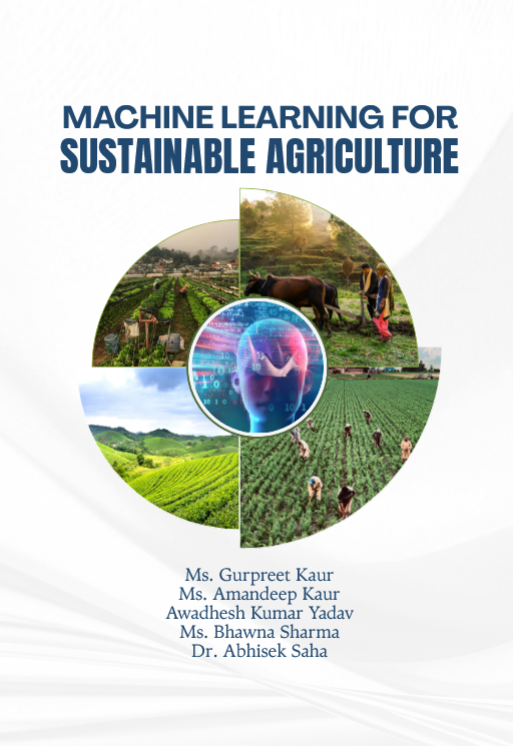
Machine Learning For Sustainable Agriculture
Ms. Gurpreet Kaur, Ms. Amandeep Kaur, Professor Awadhesh Kumar Yadav, Ms. Bhawna Sharma and Dr. Abhisek Saha
FORMAT
Paperback and e–book
ISBN
978-93-49359-96-3
PAGES
149 pages
PRICE
Rs. 1000/- ($80)

About The Editors

Ms. Gurpreet Kaur currently serves as an Assistant Professor in the Department of Computer Applications at Gian jyoti Institute of Management and Technology, Sector-54,phase-2,Mohali. Her teaching and research interests include Programming languages, web designing, AI and Machine leaning with a focus on intelligent systems and full- stack web technologies. She actively participates in academic mentoring, research guidance, and curriculum enrichment activities. Her work emphasizes experiential learning, practical problem-solving, and the adoption of emerging digital technologies in higher education. She is committed to continuous professional development and aims to contribute meaningfully to academic research and technical education.

Ms. Amandeep Kaur is an Assistant Professor in the Department of Computer Applications at Gian jyoti Institute of Management and Technology, Sector-54,phase-2,Mohali. She holds strong academic interests in machine Programming, web designing, IOT and Machine learning with a focus on applying computational techniques to solve real-world problems. She is actively involved in teaching undergraduate and postgraduate students, curriculum development, and academic mentoring. Her professional interests include emerging technologies, interdisciplinary research, and the integration of theory with practical implementation. She is committed to continuous learning, scholarly research, and contributing to quality technical education.

Professor Awadhesh Kumar Yadav is a senior academician and researcher in Botany, specializing in plant genetics, cytogenetics, and mutation breeding. He has extensive experience in undergraduate and postgraduate teaching, research supervision, and curriculum development. His scholarly contributions include publications in national and international journals and active participation in international research collaborations. His research emphasizes genetic variability, mutagenesis, and cytological analysis of crop plants, with relevance to sustainable agriculture. As an author, he aims to integrate classical botanical foundations with modern experimental approaches, presenting clear, rigorous, and globally relevant content for students, researchers, and professionals across academia and applied plant sciences. Presently associated with Sri Krishna University, Chatterpur, Madhya Pradesh as Professor & Head of Department of biological Sciences. In this modern era of AI technology, Machine Learning for Sustainable Agriculture is must to learn and read for Wider Approaches in Science and Technology.
Ms. Bhawna Sharma is an Assistant Professor at Guru Nanak Khalsa College, Yamunanagar, and is UGC NET and HTET (PGT) qualified. Her teaching and research interests are primarily centred on Artificial Intelligence and Machine Learning, with a strong emphasis on intelligent systems, data-driven models, and adaptive computational techniques. She also works in the domains of Internet of Things (IoT) and programming languages as enabling technologies for intelligent and connected environments. Her academic focus involves the study and application of AI methodologies, machine learning model development, and the integration of intelligent decision-making frameworks to address real-world and interdisciplinary problem domains. She emphasizes theoretical depth, algorithmic thinking, and experimental learning to cultivate research aptitude and analytical skills among students. She actively engages in student mentoring, research-oriented teaching, and curriculum enrichment aligned with emerging AI paradigms such as responsible AI, automation, and data-centric intelligence. She is committed to continuous professional development and aspires to contribute meaningfully to AI-driven research, innovation, and advanced technical education.

Dr. Abhisek Saha is an Associate Professor in the Department of Chemistry, at Tufanganj College, Cooch Behar, India. The career of Dr. Abhisek Saha spans over twenty-three years of academic, Research, and administrative responsibilities at various colleges, school, and universities. Dr. Saha graduated from the University of North Bengal, India, and obtained a Master’s degree in Chemistry from the same university. He completed his Ph.D. at the Department of Chemistry, Cooch Behar Panchanan Barma University, WB, India-736101. He qualified for the prestigious GATE (Graduate Aptitude Test for Engineers) examination in 2001 and CSIR-UGC-NET on Chemical Science in 2002. Dr. Saha acted as a SPOC in SWAYEM-NPTEL, X India since 2019 and faculty organizer of Spoken Tutorial, IIT Bombay, India. He acts as an Academic counselor (UG level) at Netaji Subhas Open University, India from 2015 to till date. Dr. Saha’s research interests are focused primarily on single crystal X-ray Diffraction, Synthesis, characterization and reactivity of transition metal Complexes. He is experienced in the multi-step synthesis of organic compounds as well as organometallic compounds and their separation/purification by chromatographic techniques. Possess knowledge for interpreting data from IR, NMR, UV-vis and FAB-mass spectra. Wellversed in solving structures using single crystal X-ray diffraction and possess knowledge of various softwares related to crystal structure solutions and representations (SHELXS, SHELXTL-PLUS, DIAMOND etc.). IR and UV-vis spectrophotometers, electro chemistry system (PAR- VarsastatTM II cyclic voltametry and coulometry), HPLC, GC. He worked as a Principal Investigator in the UGCsponsored project on ‘Application of platinum group metal complex to achieve C-H activation’ in 2010- 2012. The research work was the regioselective or regiospecific C(aryl)-H bond activation using cyclometallation reaction.
About The Book
Machine Learning for Sustainable Agriculture provides a comprehensive overview of how data-driven intelligence can be applied to achieve environmentally sustainable and economically viable agricultural practices. The book covers fundamental principles of machine learning and demonstrates their application in solving key agricultural challenges. Key topics include crop yield prediction, soil and nutrient analysis, pest and disease detection, irrigation and water management, climate-smart agriculture, precision farming, and decision support systems. The book highlights how machine learning models can optimize resource use, reduce chemical inputs, improve productivity, and enhance resilience to climate change. Structured in a clear and accessible manner, the book combines theoretical foundations with practical case studies and real-world applications. It serves as a valuable reference for undergraduate and postgraduate students, researchers, agronomists, data scientists, and professionals involved in smart farming and agricultural innovation. By integrating machine learning techniques with sustainability principles, this book aims to support the transition toward intelligent, efficient, and sustainable agricultural systems that can meet present needs without compromising the ability of future generations to meet their own.
Other Books

ISBN : 978-81-930928-1-1

ISBN : 978-81-930928-3-5

ISBN : 978-81-930928-2-8