
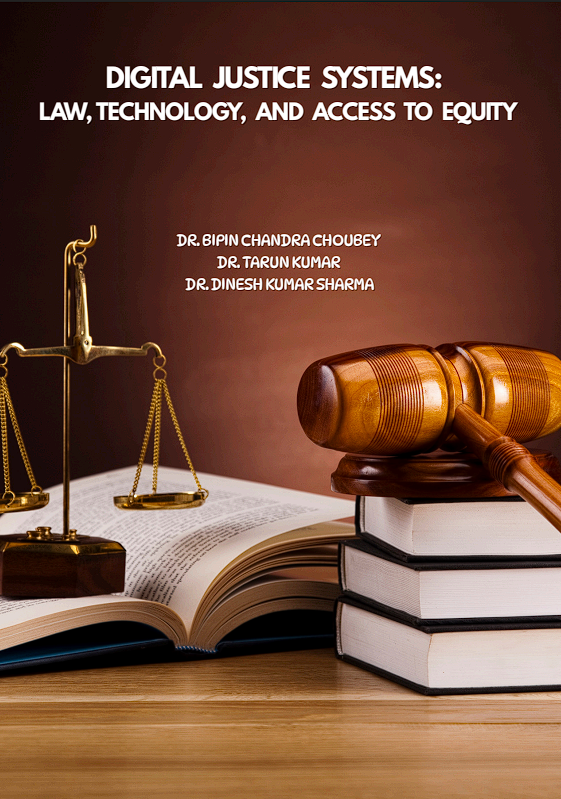
Digital Justice Systems: Law, Technology and Access to Equity
Dr. Bipin Chandra Choubey, Dr. Tarun Kumar and Dr. Dinesh Kumar Sharma
FORMAT
Paperback and e–book
ISBN
978-93-49359-65-9
DOI
doi.org/10.5281/zenodo.18604956
PAGES
165 pages
PRICE
Rs. 1000/- ($80)

About The Editors

Dr. Bipin Chandra Choubey (B.Sc., LL.M. - Gold Medalist, NET-JRF and SRF in Law) is serving as an Assistant Professor in the Department of Law, Government Law College, Gopeshwar, Uttarakhand, currently deputed as In-charge Assistant Director (Law), Directorate of Higher Education, Government of Uttarakhand. He holds a Ph.D. in Law from Prestigious Banaras Hindu University, Varanasi. His specialization and research interests include areas like Family Lay, Criminal Law and Constitutional Law. Dr. Choubey has been actively engaged in both academic and research pursuits for the last fourteen (14) years. He has published research articles in reputed Journals like Lex Localis (an International Journal), Indian BAR Review, UGC CARE listed and Scopus indexed journals. Dr. Choubey actively contributes to professional bodies, curriculum development, and policy-oriented academic initiatives, with a commitment to interdisciplinary research and education.

Dr. Tarun Kumar is Assistant Professor in Govt. Law College, Gopeshwar Chamoli Uttrakhand Since March 2019. He Holds LL. B from Campus Law Center, Faculty of Law, Delhi University. He did His LL.M. from Faculty of Law University of Delhi. He was a Senior Research Fellow in SSJ Campus Almora Kumaun University Nainital Uttrakhand. He Published Several Article in National & International Journals and participated in a number of National and International Conferences and Seminars.

Dr. Dinesh Kumar Sharma as a dedicated scholar in legal informatics, Dr. Dinesh Kumar Sharma, B.A.LL.B.(Hons.), LL.M., NET, Ph.D. from Prestigious Aligarh Muslim University, Aligarh, presently Assistant Professor in the Department of law, Government Law College Gopeshwar Uttarakhand, brings over two decades of teaching and research to 'Digital Justice System.' This text equips readers with insights into blockchain for evidence, virtual hearings, and data privacy in courts, bridging theory and India's evolving e-justice landscape."
About The Book
Digital Justice Systems: Law, Technology, and Access to Equity offer a comprehensive and interdisciplinary
examination of how digital technologies are reshaping contemporary justice systems. As courts and legal institutions
increasingly adopt electronic filing, virtual hearings, artificial intelligence–assisted decision-making, and online dispute
resolution platforms, this book critically evaluates the legal, ethical, and institutional implications of this transformation.
The book situates digital justice within constitutional principles, human rights norms, and rule-of-law frameworks,
emphasizing that technological innovation in judicial systems must remain anchored in fairness, transparency,
accountability, and judicial independence. It explores how digital tools can enhance efficiency and accessibility while
simultaneously posing risks such as algorithmic bias, data privacy violations, cybersecurity threats, and exclusion of
digitally marginalized populations. Through detailed analysis, the book examines key areas including judicial egovernance reforms, court management systems, virtual courts, artificial intelligence in legal research and judicial
administration, human–algorithm collaboration, and regulatory compliance challenges. Particular attention is given to
access to justice and digital inclusion, highlighting the impact of the digital divide on vulnerable and marginalized
communities and assessing the role of legal aid technologies in promoting equitable justice delivery.
Adopting a comparative and policy-oriented perspective, the book draws on global best practices and conceptual
approaches from different jurisdictions to illustrate how digital justice systems can be governed responsibly. Rather than
advocating full automation, it advances a human-centered model of digital justice that integrates technological efficiency
with ethical safeguards and institutional accountability.
This book is intended for legal scholars, judges, lawyers, policymakers, court administrators, researchers, and students of
law, public policy, and governance. It serves both as an academic resource and a practical guide for understanding the
opportunities and challenges of digital transformation in justice systems, making a valuable contribution to ongoing
debates on the future of law in the digital age.
Other Books

ISBN : 978-81-930928-1-1

ISBN : 978-81-930928-3-5

ISBN : 978-81-930928-2-8